


Consumers spend more time on mobile devices (smartphones, tablets) than desktops or laptop computers. Globally, the number of mobile users is increasing while mobile commerce revenues are increasing. The number of mobile users is increasing in both developed and developing countries. The global number of smartphone users, which was 1.76 billion in 2014, was estimated at 2.29 billion in 2016. In the year 2018 that number will approach the 3 billion, which constitute about half the global mobile users.
Table 1. Global Smart Phone Users, 2014-2018
| Year | Billion | % |
| 2014 | 1.76 | 37.8 |
| 2015 | 2.04 | 41.8 |
| 2016 | 2.29 | 45.0 |
| 2017 | 2.52 | 47.7 |
| 2018 | 2.73 | 49.8 |
Source: eMarketer Inc., April 2014.
This increase in the number of smart phone users supports the development of mobile commerce. While global mobile retail trade revenues are 98 billion dollars in the year 2013, it exceeds 400 billion dollars in the year 2016. In the year 2018, it is expected to approach $700 billion.
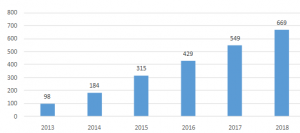
Graph 1. Global Mobile Retail Trade Revenues, 2013-2018, billion dollar
Source: https://www.statisca.com/statistics/324636/mobile-retail-commerce-revenue-worldwide/
The mobile industry is a major contributor to global growth. In 2015, its contribution to global GDP was 2.2% and it contributed to global GDP of $ 1.6 trillion. When the direct and indirect effects are considered together, the total contribution is 3.1 trillion dollars. This corresponds to 4.2% of GDP global. Mobile industry growth is expected to continue until the year 2020 and 3.7 trillion dollars in economic added value is estimated to reach. Adding new users to the mobile sector will support the economic and social contribution. At the same time, increasing mobile solutions in developing countries will improve the efficiency and added value. Although potential productivity gains are limited in developed countries, internet of objects and speed networks will be able to increase productivity in this period (GSMA, Intelligience Analysis).