



Financial globalization refers to a situation where cross-border capital flows are increasing. Capital flows consist of loans between a country and other countries, portfolio investments and direct investments. As a result of financial globalization, capital, financial assets and financial companies move from home countries to other countries and bring an increase in the foreign assets and liabilities of the country.
Financial globalization has a positive effect on economic growth through various channels and thus increases the prosperity of the country. National savings increase with financial globalization, capital costs decline and technology transfer accelerates. Both institutions and macroeconomic policies develop and financial stability increases. Financial markets in the country deepen, credit risk decreases, consumption increases, portfolio diversification and financial costs decrease. Competition increases and fiscal discipline is strengthened. However, the impact of financial globalization diminishes during periods of financial crisis, when political risk increases and when confidence in the country decreases. The country loses its financial independence, its income distribution is affected negatively, its resistance to external shocks decreases, speculative attacks increase, and bank fraud is adversely affected. That’s what Russia’s economy is going through.
The integration of Russia into the global system began with the disintegration of the Soviet Union. Although economic uncertainties and hyperinflation at the beginning limit the growth of foreign capital to Russia, foreign capital to Russia accelerates from the middle of the 1990s and comes to a standstill in 1998 with the impact of the crisis. In the early 2000s, restructuring foreign debts, both domestic and external capital flows gained momentum, with rising oil prices and economic growth and liquidity increasing significantly. The economic stability is affected positively with the effect of external conditions and grows at an annual average rate of 3.8% between 1996 and 2005. Although the growth rate has fallen in the global financial crisis, it still grows more than 3% a year from 2010-2013.
According to the financial globalization report published by the International Finance Institute, foreign private loans increased by 12 times from 2002 to 2013 in Russia. Similarly, Russia’s foreign assets reached 147% of GDP in 2013, compared to 99% of GDP in 2000. Both domestic and foreign financial flows have helped to keep Russia’s current account surplus. The rising oil prices also positively affected the current surplus of Russia and the need for foreign financing has been reduced. In addition, foreign capital flows, which have been increasing due to the influence of financial globalization, have increased the foreign exchange reserves.
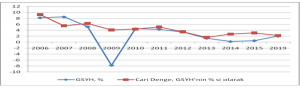
Graphics: Russia’s GDP and Current Account Balance
Source: IMF.
Financial globalization has affected Russia in other ways as well. Increased foreign fund inflows have made it possible to reduce the cost of borrowing and secure long-term funding. Russian banks have had high funding opportunities thanks to these financial flows. According to the IIF report, the pre-crisis Russian banks’ loan deposits reached 143% from the 2003 level of 93%. Similarly, portfolio flows and foreign direct investment has also increased. However, obstacles to the oil and gas sector have hampered the high rate of investment. For example, in the report, the share of bank assets in foreign bank is 6.8% level in 2004, and rises to 17% in 2013.
After 2010, the problem of Ukraine has led to the reversal of capital flows and the positive climate of financial globalization has begun to disappear, despite the fact that the growth rate and the moderate atmosphere in terms of foreign capital are in the aftermath. Russia is losing confidence by global finance. Moreover, it is deprived of the developed countries’ enormous monetary cooperation and the risk premium is increasing. The US and EU sanctions on Russia for Ukraine also reduce the effects of financial globalization. Moreover, the Ruble is being increasingly weak, monetary policy is being tightened. Domestic demand and imports are declining and growth is slowing down. For this reason, in Russia there is a need to remove obstacles in front of financial globalization, ensure political stability and restore confidence.